
Baby’s development, from play mat to first steps
Your baby's development begins in the first few weeks, lying on a mat and looking at high-contrast shapes, and continues with each new milestone: holding their head up, reaching, sitting, moving around and standing up. This selection brings together the equipment to support these stages, from play mats to playpens, as well as cloth books and activity cubes.
Every stage has its own playground.

Development activities by age, month by month
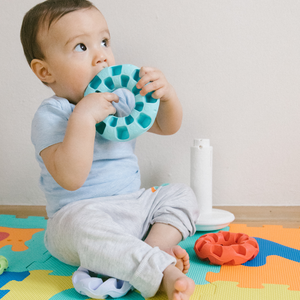
Newborns have blurry vision and mainly make out strong contrasts: black-and-white patterns and a face leaning over them from 20 or 30 centimetres away are more interesting than pastel colours. At around three months, they follow an object with their eyes and start reaching for it; by around six months, they can grab things, pass an object from one hand to the other and put everything in their mouth.
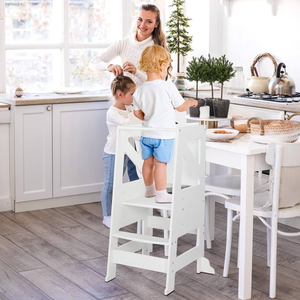
Between six and twelve months come sitting up, crawling on all fours and pulling themselves up to stand: this is the age for activity cubes, such as the Harry Potter cube by Rainbow Designs, fabric books to handle and a playpen, which provides a safe space to explore. After their first birthday, children copy adults and want to join in: a learning tower lets them reach worktop height.
Play mats, bouncers and playpens: equipment for development
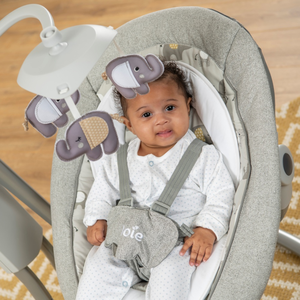
Each stage of development has its own equipment. Play mats are suitable from the first few weeks, when babies lie beneath toy arches, while bouncers keep them in a semi-reclined position so they can watch what’s going on at home. Baby swings rock little ones with a steady movement, a baby playpen gives them a safe space to play, and a learning tower brings children up to worktop height.
Tummy time: the foundation for movement
From their first few days, babies benefit from spending short periods on their tummy while awake and supervised. These sessions strengthen the neck and shoulder muscles, prepare them for rolling over and crawling, and help prevent flattening at the back of the head. Start with a few minutes, several times a day, after a nappy change or when they wake up.
A play mat is the ideal spot: its padded surface provides cushioning, and toys placed in front of your baby encourage them to lift their head and reach out. Change their position throughout the day: on their back under the toy arch, or on their tummy facing a mirror or a book propped upright. For sleep, always lay them on their back in their cot.
Bouncers, swings and playpens: how to use them safely
Bouncers and baby swings are covered by specific European standards: EN 12790 for bouncers, and EN 16232 for swings intended for babies weighing less than nine kilos or who cannot yet sit up unaided. They are for supervised play, never for prolonged sleep, and should always be placed on the floor, never on a table or bed. Keep the harness fastened and stop using the bouncer once your child can sit up unaided.
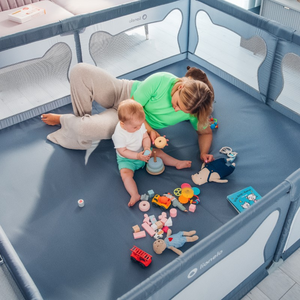
A playpen, covered by standard EN 12227, provides a safe space for your child to play while you cook. Check that the sides are locked and don’t leave a cushion or large toy inside that they could use as a step. Use a learning tower from around twelve to eighteen months, always with an adult beside them.
Choosing the right time to give a developmental toy
Play mats, fabric books and activity cubes are among the most popular new baby gifts. Black Friday baby products and the Christmas period are busy times for these purchases. Later, the winter baby products sales, the spring French Days, the summer sales and the back-to-school period are good times to update your equipment as your child develops. The baby products clearance brings together end-of-line items.
Frequently asked questions
How can I help a one-month-old baby develop?
At this age, your face is still their favourite toy: talk to them, sing and let them follow your expressions from close by. Add short tummy-time sessions and a few high-contrast pictures, without too much stimulation, as they tire quickly.
Does a baby need lots of developmental toys?
No, a few well-chosen objects, changed from time to time, are more than enough. A rattle, a fabric book, an activity cube and a play mat cover the essentials for the first year; the rest comes from interaction with adults.
Can screens help a young child develop?
No: French guidelines advise against any screen exposure before the age of three, including videos presented as educational. Young children learn by handling objects and interacting with the people around them.
Is a fabric book suitable from birth?
Yes, it’s one of the first kinds of book you can give them: they can crinkle it, chew it and wash it. The soft Hogwarts Express book by Rainbow Designs, inspired by the Harry Potter universe, also makes a lovely new baby gift for parents who are fans of the series.
When can you start using a playpen?
A playpen becomes really useful at around six to eight months, when your baby starts moving around and you need somewhere safe to put them for a few minutes. Before then, it can be used as a play area with a mat inside, helping them get used to it.













